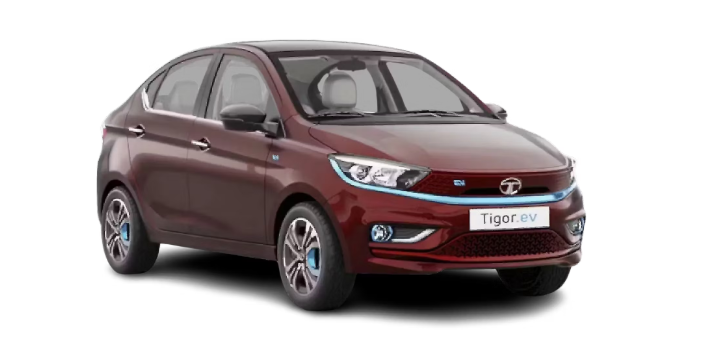
The Tigor.ev remains one of the few compact electric sedans in India, which gives it a distinct use case. Its appeal is strongest for buyers who want a conventional boot, predictable urban running and home charging, but the decision should be based on range needs and charging access rather than fuel savings alone.
Where the Tigor.ev sits today
The Tata Tigor EV starts at around Rs. 12.49 lakh ex-showroom and uses a 26 kWh battery pack with a certified range of 315 km. Tata also quotes a 0–60 km/h time of 5.7 seconds and DC fast-charging capability of about 59 minutes under specified conditions. Those figures make it suitable for city use with some intercity flexibility, but they are not a substitute for route planning.
The current variant structure is straightforward and mainly adds convenience as you move upward. Exact prices should be confirmed for your city at booking because the manufacturer can revise ex-showroom figures and variant availability.
| Variant | What it adds over the previous level |
| XE | Core safety, climate control, connected features, 3.3 kW AC charging |
| XT | 7-inch touchscreen, four speakers, all power windows |
| XZ+ | Projector lamps, camera, eight speakers, cruise control |
| XZ+ LUX | Premium seat and steering trim, contrast roof treatment |
City use is where the ownership case is easiest to build
An EV is most convenient when the car can return to a predictable charging point overnight. If your daily running is 30–60 km and the vehicle is parked at home for many hours, the Tigor.ev can begin most mornings with more range than the day requires. That removes the need to treat public fast charging as the default refuelling method.
Apartment residents should confirm charging permission, electrical load and parking allocation before paying a booking amount. A theoretical charger network near your neighbourhood is not equivalent to a dependable personal charging routine. If home charging is uncertain, spend time mapping reliable public or workplace chargers and their operating hours.
What about weekend highway trips?
Weekend use is possible, but it requires more planning than the daily commute. Highway speed increases energy use, and air-conditioning, passengers, gradients and weather can reduce the distance available between charging stops. Plan using a conservative range buffer and choose charging locations with a backup nearby rather than arriving with a nearly empty battery.
A simple trip-planning table can prevent range anxiety from becoming a last-minute problem. The key is to treat charging as part of the route, not as something to solve after the battery becomes low.
| Trip question | Practical check |
| Distance to destination | Keep a meaningful battery reserve rather than using the full certified range |
| Primary charger | Verify connector, operating status and access hours |
| Backup charger | Identify a second location before departure |
| Arrival charging | Check whether the destination allows overnight charging |
| Return leg | Plan around traffic and detours, not only map distance |
Tigor petrol mileage is not the right benchmark for every EV buyer
A shopper comparing the Tigor.ev with an internal-combustion sedan may naturally search for Tigor petrol mileage, but the ownership calculation should use total energy cost, not mileage units alone. Compare your current monthly petrol bill with estimated home electricity consumption, then add the EV’s higher or lower purchase price, insurance and charging setup.
If you drive only a few thousand kilometres a year, fuel savings may take a long time to offset an EV price premium. High predictable city running generally strengthens the EV case, especially when most charging happens at residential electricity rates rather than public fast-charging tariffs.
Battery warranty and long-term ownership
Battery warranty terms deserve the same attention as the vehicle price because the high-voltage battery is central to long-term EV ownership. Read the current warranty document for coverage period, ownership conditions and exclusions rather than relying on a salesperson’s summary. Also ask how battery health is diagnosed and what service support is available in your city.
Finance without hiding the charging cost
If you finance the car, include the home-charging setup in the purchase budget even when the charger itself is bundled or subsidised. Compare loan offers using the same down payment and tenure, and keep enough cash for insurance and unexpected household expenses. A lower fuel bill does not make an oversized EMI comfortable.
Check destination charging before a Tigor.ev road trip
Hotels, offices and relatives’ homes may have sockets but not every outlet is appropriate for EV charging. Confirm whether charging is allowed, what power is available and whether the parking bay can remain occupied long enough. On a route you use repeatedly, save two charging alternatives rather than one. That small planning habit makes weekend travel more predictable and reduces dependence on a single station being operational.
Conclusion
The Tata Tigor EV can still be a practical 2026 choice for buyers with predictable city travel, secure home charging and a preference for a sedan boot. It becomes less straightforward when charging access is uncertain or frequent long-distance travel is central to the use case. Build the decision around your weekly route first, then compare the savings.
Leave a Reply